
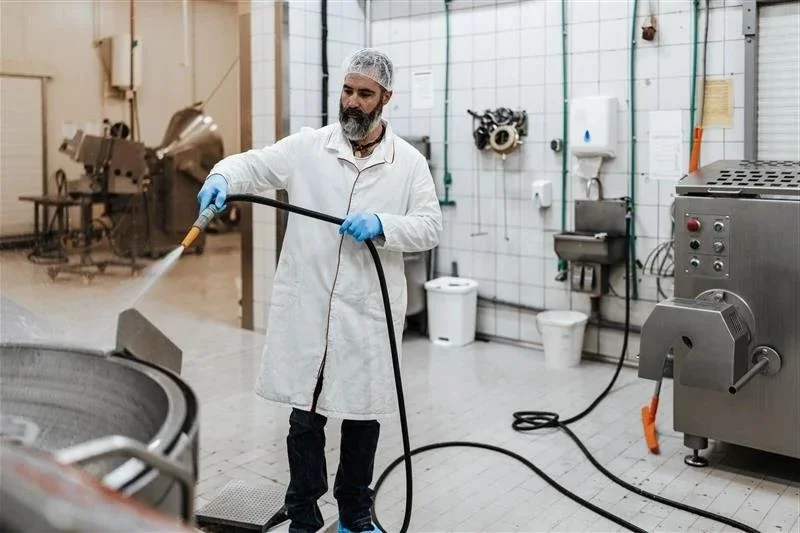
Industrial Cleaning
Real World Challenge
In the food and drink sector, clean-in-place (CIP) processes are critical to ensuring hygiene, food safety, and product quality. However, without reliable inline monitoring, cleaning cycles are often run for longer than necessary. This over-cleaning wastes water, energy, and cleaning chemicals, increases downtime, and adds unnecessary carbon emissions.
The contribution of each cleaning parameter to the scalarised economic, carbon footprint, and water use objective functions during the 10 trials of the Bayesian optimisation procedure for the low electricity price scenario.
The challenge is that current CIP systems cannot reliably detect when fouling has been fully removed from equipment surfaces. Visual inspection is rarely possible, and traditional monitoring methods struggle in opaque or complex pipe networks. In addition, cleaning requirements vary depending on the type of fouling material, production conditions, and equipment design. This means cleaning schedules are typically fixed and conservative — sacrificing efficiency for safety.
Manufacturers need intelligent, adaptive cleaning systems that can detect cleaning endpoints in real time, adjust parameters dynamically, and optimise the process across multiple objectives — including cost, sustainability, and hygiene compliance.
Intelligent sensing process for resource efficiency. The steps in the green boxes are directly related to the resource efficiency problem, the orange boxes to the sensor aspects and the blue to the machine learning process. Solid arrows indicate the main direction of methodology, thick dashed lines indicate scenarios that require a return to a previous step and thin dashed arrows indicate stages that will undergo iterative improvement.
Our research demonstrates that:
Ultrasonic sensing + ML can detect fouling presence and cleaning completion with up to 99–100% accuracy across a range of food materials and pipe types, even in opaque systems.
Bayesian optimisation can find optimal cleaning parameters (temperature, flow rate, chemical concentration) after testing as few as nine parameter combinations, achieving near-global optimum performance while minimising production disruption.
Real-time adaptive cleaning is possible — ultrasonic sensor data can dynamically adjust cleaning parameters during operation, improving efficiency by up to 4.8% and reducing resource use.
Transfer learning enables sensor models to be applied to new equipment or processes without collecting large labelled datasets, with prediction accuracies up to 98.4% for cleaning endpoint detection.
Process design innovations, such as swirl pipes, can boost CIP efficiency by over 40% at typical industrial flow rates, further shortening cleaning cycles and saving resources.
By integrating these capabilities, our intelligent cleaning systems allow manufacturers to:
Reduce water, energy, and chemical use without compromising hygiene.
Shorten cleaning downtime, increasing production capacity.
Lower operational costs while improving sustainability metrics.
Adapt cleaning schedules to real fouling conditions, not just fixed time intervals.
At the Food AI Lab, we are developing intelligent industrial cleaning technologies that combine low-cost sensors (ultrasonic, optical) with machine learning and Bayesian optimisation to transform CIP from a fixed routine into a smart, responsive process.
Our AI Solution
US amplitude, energy and RMSE during the first repeat of the cleaning of malt at 12C and 6 l/min (top). Images from the side (top row) and top (bottom row) webcams taken at different times during cleaning are shown with the corresponding time indicated by the number of the top figure.
This AI-driven, sensor-enabled approach is a key step toward Industry 4.0 food manufacturing, where processes are self-optimising, sustainable, and fully integrated.
This research has been performed collaboratively over a number of projects with researchers from Loughborough University and the University of Nottingham, Ningbo campus with funding from the EPSRC and IUK.